The Family’s Move to San Antonio
Like Water for ChocolateThe Family’s Move to San Antonio is both a practical response to Rosaura’s need for medical care and a painful separation for Tita. Mama Elena presents the move as a way to protect her daughter and provide for her household, but Tita hears that Roberto will be taken from her. After the family leaves, her attention to the ranch and to life beyond caring for a pigeon nearly disappears; the later uncertainty about the family’s safety shows how the move unfolds amid the isolation and danger of the revolution.
Medical reasons and the proposed move
Mama Elena raises the plan while speaking with Father Ignacio in Tita’s hearing. She worries that Rosaura may need a doctor and that, as at Roberto’s birth, no doctor will be available. Her proposal is conditional on Rosaura recovering her strength: afterward, Rosaura could live with Mama Elena’s cousin in San Antonio, together with Pedro and their little boy, where she could receive better medical attention. The move is thus framed first as a response to an immediate vulnerability, not simply as a change of residence.
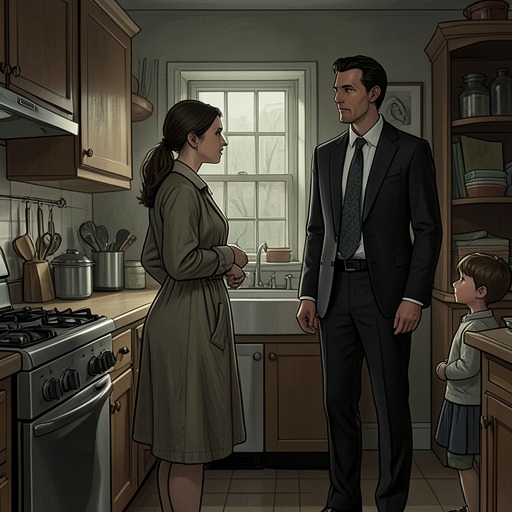
Father Ignacio objects that the political situation makes a man necessary to defend the house. Mama Elena rejects the assumption that she needs a man, pointing to her ability to manage the ranch and her daughters on her own. She also minimizes the danger of the revolution, contrasting it with a kitchen problem. Her reply makes the disagreement about more than logistics: Father Ignacio sees the household’s security as dependent on male protection, while Mama Elena asserts her own authority and treats the move as a decision she can arrange.
Employment and Tita’s alarm
Mama Elena answers the practical question of Pedro’s livelihood with a specific plan. He can work as an accountant in her cousin’s company, and his English, she says, will present no obstacle. The proposed relocation therefore has two stated supports: medical attention for Rosaura and employment for Pedro. The conversation offers a route for the family to establish itself elsewhere without explaining how every detail of the move will be carried out.
For Tita, however, the plan’s most urgent consequence is the possibility of losing Roberto. The words about San Antonio echo in her mind, and she thinks that the child cannot be taken from her. Mama Elena’s announcement ruins the party for her, even though it is the first party Tita has enjoyed. The contrast gives the scene its emotional turn: a gathering that had offered Tita rare pleasure becomes the setting in which she learns that the family’s departure may sever a bond she cannot bear to lose. The move is not presented to her as an abstract arrangement; she experiences it through the threatened absence of the child.
Departure and wartime separation
The move does take place: Pedro, Rosaura, and Roberto go to live in San Antonio. In its aftermath, Tita loses interest in almost everything except feeding worms to a helpless pigeon. Even the possibility that the house might fall no longer seems to matter to her. This stark change makes the departure consequential beyond the family’s changed address. The ranch remains the setting of her daily life, but its routines have lost their hold on her.
Revolutionary disruption compounds the separation. When soldiers later approach the ranch, the household has not heard from the family, and those remaining fear that something bad may have happened. Nicholas has not returned with replacement cattle, which he had been forced to buy after scarcity led to the slaughter of animals on which the ranch depended. Felipe has been sent to San Antonio for news of Pedro and his family. The move therefore leaves relatives at the ranch waiting for information at a moment when shortages, travel, and armed incursions make ordinary contact uncertain.
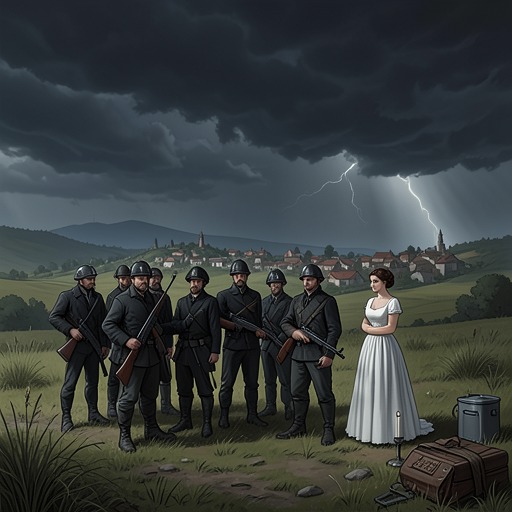
The soldiers’ arrival also shows the different dangers confronting those who remain. Rosalio warns that a troop is approaching; Mama Elena takes up her shotgun and orders Tita and Chencha to hide in the cellar. She meets the captain herself, with Rosalio and Guadalupe beside her, and the soldiers are told not to enter the house. They nevertheless seize doves from the large roof-top dovecote, enough to feed their battalion for a week. The episode does not explain the family’s decision to move, but it places their absence against the increasingly precarious life at the ranch and makes the separation part of a broader wartime uncertainty.
Absence, return, and family memory
The separation is still apparent when Gertrudis later returns to the family home. She learns from Tita that Mama Elena has died; she had come intending to show her mother the life she had made, as a revolutionary general and Juan’s wife. Her return makes absence irreversible: the reunion she hoped for cannot happen. The episode also returns attention to the household’s inheritance. Over supper, Gertrudis recognizes that neither she nor Rosaura knows how to prepare the family recipes and hopes Tita will live long enough to continue them. The family’s dispersal therefore carries more than a loss of daily company: it exposes how much memory and continuity remain concentrated in the person who stayed at the ranch.
The move’s significance lies in the unequal meanings it acquires. For Mama Elena, it is a practical plan built around Rosaura’s health and Pedro’s employment, defended as a matter of household authority. For Tita, the decisive fact is that Roberto will be farther away. For those left behind, the family’s absence becomes harder to bear amid revolutionary danger and interrupted news. San Antonio offers the departing family a proposed place to live and work, while the ranch becomes a place of waiting, changed routines, and belated recognition of what distance has cost.